The Slow Extinction of the Cultivated Interior
The Texture of Thought
The first thing one noticed upon entering certain houses in London — before the flowers arranged with studied negligence in their cracked vessels, before the paintings hung with a connoisseur's contempt for symmetry, before the silver left to tarnish quietly beside the sink as if time itself were a decorating choice — was the density of thought. Not mere intelligence, though intelligence was abundantly present, stacked in tottering monographs and annotated margins and library chairs worn to a rich exhaustion by decades of sustained use. Thought, in these rooms, possessed texture. It gathered in the air like woodsmoke. One understood at once, and without being told, that life inside these walls had been edited rather than decorated — that each object had survived a long private reckoning with its own necessity.
There are fewer such interiors now.
Once, they constituted a recognizable civilization of rooms extending from Bloomsbury to the Upper East Side, from the discreet apartments of the Left Bank to the old houses of Belgravia where curtains had absorbed, over generations, the particular fragrance of coal dust and old bindings. These were not "luxury interiors" in any contemporary sense of that corroded phrase, nor were they minimal, curated, branded, or optimized for publication in any periodical devoted to the aspirational life. They were accumulations of judgment, made visible. They belonged to people who believed — often unconsciously, in the way one believes in grammar — that one's surroundings were inseparable from one's intellectual and moral existence.
Taste, in these rooms, was not consumption. It was discipline.
Civilization as Interior Decoration
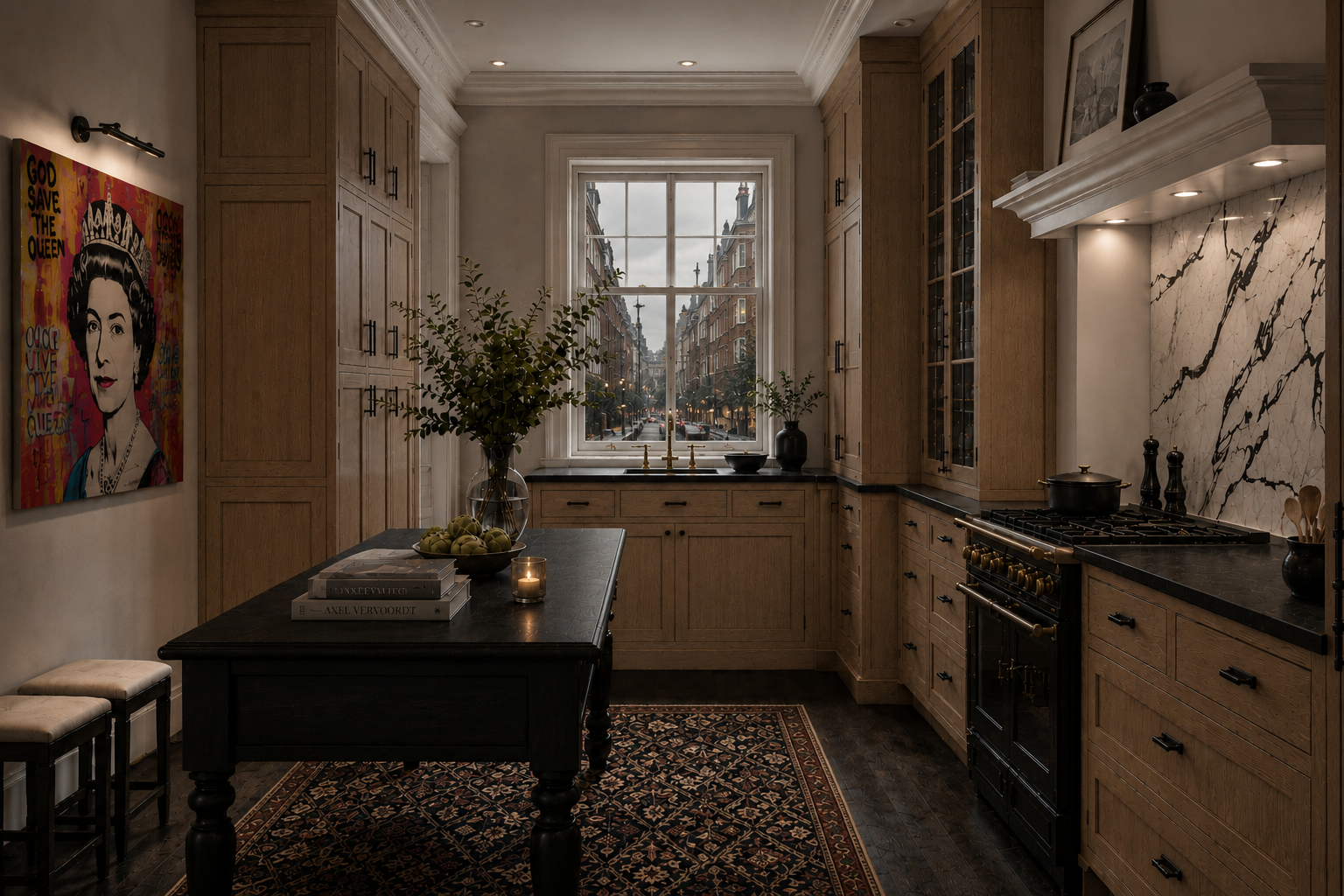
A darkened London kitchen at dusk still carries traces of this vanished ethic, if one knows where to look. Oak cabinetry stained nearly black by shadow. Marble bearing the dramatic veining of its geological origin, more elemental than pristine. Books left open on the worktable: not performative books arranged by a stylist with an eye toward the camera, but books interrupted mid-thought, their spines relaxed, their margins filling with the residue of someone's attention. A candle burning beside a bowl of fruit. Brass worn to a particular amber by the passage of hands. Beyond the window, Georgian facades descending through rain into evening. One imagines a saucepan at a quiet simmer somewhere beyond the frame, while a conversation about Francis Bacon or Harold Pinter drifts in from an adjoining room. The atmosphere is not decorative. It is civilizational.
For much of the twentieth century, the cultivated interior functioned as a repository of culture itself. Before the advent of digital abundance, before culture dissolved into streams and feeds and the endlessly circulating images of our current informational climate, knowledge resided physically inside rooms. One learned by proximity — to bookshelves, to paintings, to dinner conversations conducted with some expectation of sustained argument, to the inherited rituals of arrangement and hospitality that governed how educated people moved through domestic space. A house was not simply where one lived. It was where one assembled a worldview, and continued, year by year, to revise it.
Virginia Woolf understood this with characteristic intuitive precision. The rooms of Bloomsbury — imperfect, bohemian, intellectually charged to an almost uncomfortable voltage — were radical not because they were fashionable but because they rejected the heavy moral suffocation of late Victorian domesticity. Vanessa Bell painted walls and furniture not as mere aesthetic gesture but as declarations of intellectual freedom, proposing that the boundary between art and lived experience might productively dissolve. Charleston Farmhouse, with its hand-painted surfaces and studied informality, suggested that taste could serve as argument — specifically, as an argument against spiritual deadness.
Yet Bloomsbury's true legacy was not a visual style. It was the idea that interiors could shape consciousness.
This notion survived the war in surprising, austere forms. Postwar London, exhausted and rationed, produced a strange civilizational flowering: a cultivated austerity at once forced by circumstance and chosen by temperament. Photographs of Mayfair and Chelsea interiors from the nineteen-fifties reveal rooms that appear now almost impossibly restrained — faded Turkish rugs, books on every horizontal surface, the weak light of an English winter, inherited furniture cohabiting with modern paintings acquired before they became expensive. These were not "designed spaces." They were intellectual habitats. One senses, looking at them, people reading there for hours at a time, in the undistracted manner that has become nearly extinct.
The historian Peter York once observed that the old British upper classes possessed an instinctive understanding of comfort without display. The ideal room was slightly worn, deeply personal, faintly underheated, and impossible to reproduce commercially because its authority derived from time rather than from money. The contemporary luxury market has spent decades attempting to imitate this atmosphere and almost invariably fails because it mistakes patina for meaning.
Meaning cannot be purchased wholesale.
The Ethics of Arrangement
The Belgian designer Axel Vervoordt came closest to translating the old cosmopolitan interior into a modern global language. His rooms — spare yet soulful, monastic and simultaneously sensual in a way that defied the usual opposition — reintroduced silence into luxury culture with something approaching missionary determination. Vervoordt understood that emptiness achieves beauty only when shaped by discernment. His interiors were filled with considered absence: rough plaster walls, imperfect linen, ancient objects placed with an almost religious restraint. But unlike the sterile minimalism that dominated the late twentieth century — which evacuated meaning along with possessions — Vervoordt's spaces remained tethered to history. They carried memory as a structural element.
What distinguished the great cosmopolitan interior from mere wealth was precisely this relationship to time.
Old New York apartments once possessed it in abundance. On the Upper East Side particularly, a generation of collectors, editors, writers, and cultural patrons maintained homes that functioned as dense archives of civilizational aspiration. The decorator Mario Buatta famously cultivated an extravagant Anglo-American sensibility — chintz, grandeur, theatrical accumulation — but beneath the theatricality lay something more serious: the continuation of domestic life as cultural stewardship. Such apartments held paintings acquired before the art market became speculative theatre. They held first editions, inherited porcelain, old silver, photographs signed by figures who had passed from notoriety into legend. They were not museums, precisely, because they were still lived in. Cigarette smoke yellowed the lampshades. Dogs scratched eighteenth-century chairs. Ice clinked in heavy glasses while people argued about books that had been read rather than merely displayed.
One notices, looking at photographs of such rooms now, how strikingly little self-consciousness they contained.
Contemporary interiors are acutely, even anxiously, aware of being seen. The social platforms that emerged in the second decade of this century altered domestic space profoundly by converting private rooms into public images — by installing an imaginary audience at every table and in every corner. The room ceased to be a sanctuary for thought and became instead a backdrop for the performance of identity. Taste migrated from cultivation to signaling. The result is an odd flattening effect now visible across the international bourgeoisie: homes in Nashville, Copenhagen, Sydney, Los Angeles, and London increasingly resemble one another more closely than neighboring houses once did. The algorithm has replaced regional culture with something more efficient and considerably less interesting.
The Performance of History
This homogenization has unfolded simultaneously with the disappearance of the intellectual domestic life that once produced memorable interiors. The great cosmopolitan room depended upon certain rhythms of daily existence that have largely vanished: the lingering dinner party conducted without reference to anyone's obligations the following morning; the private reading habit pursued for hours rather than minutes; the unhurried solitude that permits genuine thought; the inherited library built by one's predecessors and extended, generation by generation, with the deliberation appropriate to a long project. Such interiors were built slowly because the people inhabiting them believed — or simply assumed, which is the more durable form of belief — that their lives unfolded slowly too. The room evolved alongside the mind.
Today's homes are often designed all at once, purchased in nearly completed form from the aesthetic marketplace, which offers atmosphere as a product category. One now orders interiority like a subscription service. Entire industries have arisen devoted to manufacturing instant patina: artificially aged oak, pre-distressed brass, reproduction antique rugs washed to simulate the fading of footsteps that never occurred. The performance of history has become more profitable than history itself, which is perhaps the most efficient summary of our cultural moment.
And yet the longing persists.
This may explain why certain cinematic interiors continue to exert such disproportionate power over the imagination. One thinks of the London townhouse in Paul Thomas Anderson's Phantom Thread, where breakfast trays and polished silver become instruments of emotional warfare, the domestic object freighted with a significance it can barely contain. Or the Milanese apartments of Luca Guadagnino's films, where books and architecture generate an erotic atmosphere that exists entirely independent of plot — rooms as protagonists, in a sense. Nancy Meyers's interiors, often subjected to mockery for their aspirational polish, nevertheless disclose a widespread and genuine hunger for cultivated domestic abundance. Even television has absorbed the language of old-world interiority as shorthand for seriousness, intelligence, and moral complexity — the loaded bookshelf functioning now as cinematic shorthand for a character worth watching.
We still instinctively understand the symbolic power of rooms. This recognition is itself a kind of archaeology.
Lucian Freud's studio embodied the antithesis of decorative refinement yet belonged unmistakably to this same lineage. The paint-encrusted chaos of his Holland Park quarters — the stained floorboards, the exhausted rags, the furniture destroyed by the indifference of total absorption — represented a life entirely consumed by the act of looking. Freud's rooms were not orderly, but they possessed the density of complete commitment. Civilization, it bears remembering, is not neatness. It is attention.
Against the Frictionless
The old idea of taste contained an ethical dimension now considered faintly embarrassing in cultivated circles, as if the admission of aesthetic standards implied some discreditable exclusion. To cultivate oneself aesthetically was once understood as a component of becoming fully human — neither vanity nor snobbery, but a form of moral seriousness. Matthew Arnold's definition of culture as "the best that has been thought and said" now sounds, it must be admitted, unbearably patrician. Yet behind it lay a genuine conviction that beauty, literature, architecture, and conversation shaped moral perception in ways that nothing else could replicate. One arranged a room not simply to impress one's guests but to train one's own sensibility — to surround oneself with objects that demanded something in return.
Susan Sontag's apartments reflected this seriousness with compelling clarity. Books occupied every available surface. Art existed not as investment or as décor but as intellectual companionship. The atmosphere was severe and intimate simultaneously. One senses in photographs of those rooms a mind in continuous dialogue with the objects surrounding it — the room as autobiography, the shelves as argument.
Contrast this with the contemporary luxury interior, whose defining characteristic is frequently emotional neutrality. High-end residential spaces today often aspire toward a frictionless perfection that communicates wealth with admirable efficiency while saying almost nothing about inner life. Pale oak. Hidden appliances. Museum-quality lighting deployed in service of living rather than contemplation. Furniture that appears never to have been inhabited by a body in any state of agitation. Such environments are optimized for visual consumption; they are rooms one might experience through a screen with very little lost in translation.
Perhaps this explains why darker, moodier interiors have returned so forcefully to cultural favor in recent years. The renewed passion for English townhouses, old libraries, lacquered cabinetry, the specific quality of candlelight, and the richly layered textile — this suggests a broader cultural fatigue with exposure, brightness, and the compulsory transparency of contemporary life. People increasingly desire rooms that conceal rather than display. Shadow itself has become a luxury item.
The kitchen at dusk — rain beyond the window, black marble catching low, oblique light — belongs to this emotional geography. It evokes not aspiration exactly but refuge, and the distinction matters. One imagines arriving there late in the evening after the city has finished with one. The room requires slower habits: the extended meal, the book left open on the table, wine in glasses heavy enough to hold with both hands, conversation conducted in the register appropriate to the hour. It resists acceleration. This resistance may be the last surviving function of the cosmopolitan interior.
The Inner Life and Its Discontents
For centuries, the cultivated room protected certain forms of inwardness from the pressures of the exterior world. The Paris salon, the Viennese study, the Bloomsbury sitting room, the Manhattan library — these spaces enabled concentration and conversation precisely because they were enclosed worlds, governed by their own standards of attention, insulated from the noise demanding admittance at every window. Civilization survived there in miniature, maintained by people who understood that the miniature required maintenance.
Now, however, private and public life increasingly collapse into each other with a thoroughness that would have seemed dystopian to an earlier era. Phones dissolve solitude before solitude can become productive. Work infiltrates every room. Homes become content. The distinction between interiority and performance erodes daily, quietly, in ways one notices only by their cumulative effect. Under such conditions, the old cultivated interior begins to appear not merely old-fashioned but faintly subversive — a form of resistance to the cultural logic of total exposure.
To build a room for thought today requires resisting considerable cultural pressure.
One must resist speed, disposability, algorithmic sameness, and the constant, low-frequency demand for visibility. One must hold, somewhat unfashionably, to the belief that certain objects deserve to remain in one's possession for decades; that books matter as physical objects, not merely as containers of text; that the quality of light alters the quality of thought; that a meal should linger past the point of satiety; that beauty can deepen moral perception rather than merely advertise social position. These are not extravagant convictions. They once constituted common sense.
This is why truly memorable interiors remain so rare.
The great cosmopolitan rooms were never the products of decoration alone. They emerged from entire ecosystems of education, sustained reading, travel undertaken with curiosity rather than itinerary, decades of collecting, the weight of inheritance, and conversation conducted among people who disagreed with one another on matters of genuine importance. They required people who understood culture not as content — not as a stream of material to be consumed and refreshed — but as obligation. Such individuals persist, though increasingly at the margins of the modern world. One encounters them occasionally in old apartments in Paris or London where the internet signal is unreliable and the bookshelves have begun to constitute a structural concern. The rooms are imperfect. Lamps lean at angles that suggest a long history of being moved for reading. Kitchens carry the accumulated fragrance of onions and old wood. Nothing matches entirely. Yet one feels, upon entering, an immediate and inexplicable calm, as if the room itself were engaged in a quiet form of thinking.
What We Mourn
What we mourn in the disappearance of the cosmopolitan interior is ultimately not luxury — luxury being cheaper and more available than at any previous point in human history — but density. The density of accumulated judgment. The sense that a human life, carefully and attentively lived, leaves visible traces in space, and that those traces constitute a form of meaning unavailable elsewhere.
The modern world excels at circulation and struggles with permanence. Images travel faster than ideas ever could. Trends displace traditions before traditions have had time to mature into the authority they require. Rooms once designed to hold memory are now redesigned every five years to maintain relevance within an endlessly refreshing visual economy. Even the language surrounding domestic life has shifted, quietly but decisively, from cultivation to optimization. Homes are expected to perform.
And yet some stubborn, inarticulate instinct continues drawing people back toward older forms of domestic existence. Young collectors still haunt the secondhand bookshops of Bloomsbury and the Left Bank in search of out-of-print editions whose value is entirely personal. Designers continue studying the apartments of Yves Saint Laurent, Pauline de Rothschild, and Cy Twombly — not because these interiors were fashionable, but because they possessed conviction. And conviction, in an age of comprehensive aesthetic optionality, is increasingly the rarest thing.
Late at night, in certain London houses, one can still glimpse remnants of this older civilization through uncurtained windows. Pools of amber light. Shelves running floor to ceiling without apparent end. Paintings hung with the confidence of long acquaintance. Someone reading alone beside a lamp while rain darkens the square outside and the city continues its business, indifferent. These scenes retain their extraordinary emotional power because they suggest that the inner life has not yet entirely capitulated.
The last great cosmopolitan interior may ultimately survive not as a style to be imitated or a market category to be monetized, but as an attitude — the stubborn, civilizing belief that how we live shapes how we think, and that how we think shapes, incrementally, the world we inhabit together. This is, finally, what the rooms were always for.