Warmth Before Decoration
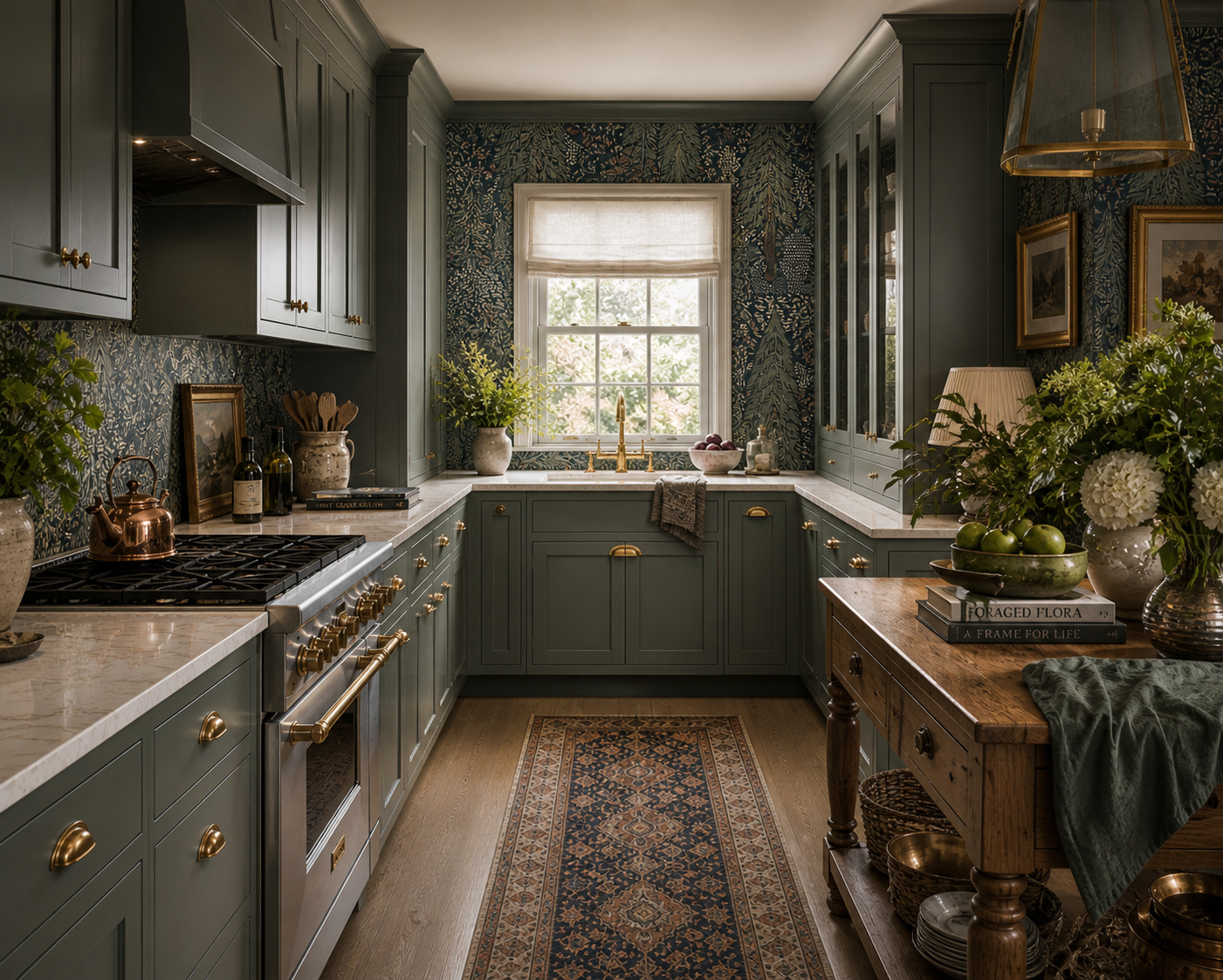
Wallpaper began not as decoration, but as warmth.
In sixteenth and seventeenth-century Britain, the first wallpapers appeared not in grand reception halls or drawing rooms, but in cupboards, alcoves, passageways, and secondary rooms — spaces where tapestries and woven textiles were a financial impossibility. Early English papers imitated what most households could not afford: leather wall coverings, imported fabrics, the luxury of dressed surfaces. Wallpaper was, from its origins, a democratic material. An act of civilisation in rooms that might otherwise have none.
This is the history that explains what many modern interiors have forgotten.
Wallpaper was never confined to formal rooms. By the nineteenth century, it had moved through the whole body of the English house — into kitchens, sculleries, pantries, corridors, and utility passages. When the wallpaper tax was repealed in 1836 and industrial printing made paper genuinely affordable, it settled into the practical architecture of daily life and stayed there. The English did not treat their kitchens as showrooms. They treated them as rooms — layered, habituated, accumulating character over decades. Wallpaper was part of that accumulation.
Walk through any historic English country house and the evidence is still there: butler's pantries in faded florals, breakfast rooms lined in soft botanical repeats, utility passages wrapped in small-scale patterns worn gently by generations of use. These rooms do not announce themselves. Their beauty is the beauty of occupation — surfaces shaped by steam, light, conversation, and time rather than by any deliberate act of display.
William Morris understood this instinctively. His wallpapers — dense with leaves, vines, hedgerows, and woodland forms — were never conceived for grand gestures. They carried a philosophy: that ordinary domestic life deserved craftsmanship, that the rooms where people actually lived were as worthy of beauty as the rooms where they performed it. The papers that came from his workshops gave the English interior a language it has never entirely abandoned. Pattern rooted in nature. Repetition as a form of calm. Softness as an architectural value.
That philosophy is not historical sentiment. It shapes the finest kitchens being made today.
The best British kitchen makers deploy wallpaper architecturally, never decoratively. A paper appears behind a range alcove, inside a pantry recess, above a dado, wrapping a breakfast corner. It is never the focal point. It functions instead as a tonal bridge — between cabinetry and light, between timber and stone, between the new and the aged. Brass reads warmer against it. Painted millwork gains depth. Daylight moves differently across a papered wall throughout the day, particularly under the shifting grey skies that have shaped English interiors for centuries.
In climates where strong sunlight makes stark plaster walls crisp and luminous, bare surfaces work. Under English skies, texture becomes load-bearing. Wallpaper, limewash, aged timber, and layered textiles are not stylistic choices — they are responses to the quality of the light. They give rooms warmth and dimensionality on the afternoons when the light offers neither.
Kitchens have drifted dangerously toward the over-engineered: hard stone, polished metal, slab surfaces, concealed appliances, task lighting calibrated for surgery. Wallpaper reintroduces vulnerability. It insists that a kitchen is not a laboratory. It is an inhabited place — shaped by repetition, weather, conversation, memory, and the particular disorder of daily life. A room that looks lived-in because it has been.
The papers that endure in kitchens are never loud. They are faded botanicals, small block prints, muted stripes, earth-based colours — softened greens, tobacco browns, soot blues, parchment tones. Patterns that reveal themselves slowly rather than declaring themselves immediately. Many of the most enduring are still produced through traditional methods: woodblock, lino-cut, hand-screened processes that preserve the slight irregularities and visible tactility that give a room humanity. The hand-printed papers of designers like Marthe Armitage survive precisely because their imperfection is the point.
Historically, kitchen papers faded. Steam softened their edges. Sunlight altered their pigments. Corners lifted over decades. None of this diminished the room. It deepened it. A kitchen that has been lived in looks different from a kitchen that has merely been installed, and wallpaper is one of the few materials that records that difference honestly.
The contemporary obsession with smooth, immaculate surfaces produces interiors that are, in the end, placeless. Beautiful perhaps — but emotionally thin. White drywall and seamless slab kitchens could belong anywhere and therefore belong nowhere. Wallpaper gives a room specificity. It suggests the room belongs somewhere and to someone.
The best kitchen papers are chosen for atmosphere, not statement. Used with restraint and architectural intelligence, they do something no hard surface can: they make the room feel settled rather than merely finished.
In the finest kitchens, you do not notice the wallpaper first.
You notice the atmosphere it has made.