The Beauty of Utility
There is a particular kind of room that no longer gets built, and its absence is felt more keenly than most people can quite articulate.
Not the grand room. Not the room designed for arrival or impression. The other kind — the room behind the room. The pantry with its cool stone floor and smell of flour and beeswax. The scullery with its deep fireclay sink and painted shelves stacked with ironstone. The boot room heaped with waxed jackets and the particular damp of an English autumn coming in from the fields. These were the rooms in which English domestic life actually occurred, and they were, almost without exception, the most beautiful rooms in the house.
Beauty was not the intention. That is precisely the point.
The English home evolved around use rather than appearance, and in doing so produced interiors that no amount of deliberate decoration has quite managed to replicate. Scullery shelves worn smooth at their edges. Hardwood floors hollowed at the threshold where feet returned to the same spot across generations. Copper pans darkened and brightened in alternating patches from years of polishing beside the same window on the same morning each week. Unlacquered brass softened around the latch where a thumb had pressed it ten thousand times. These surfaces did not age gracefully because someone had chosen materials with patina in mind. They aged gracefully because nobody had thought to prevent it.
This is the distinction contemporary interiors consistently fail to grasp.
The modern kitchen conceals its working life with considerable ingenuity. Appliances retreat behind cabinetry. Storage disappears into seamless joinery. Surfaces extend in unbroken planes of engineered stone. The room achieves a kind of visual silence — immaculate, considered, and strangely uninhabited, as though the family had moved out that morning and forgotten to mention it. It is a room designed to be seen rather than used, and one senses this immediately upon entering.
The English kitchen, at its finest, has always worked from the opposite premise entirely.
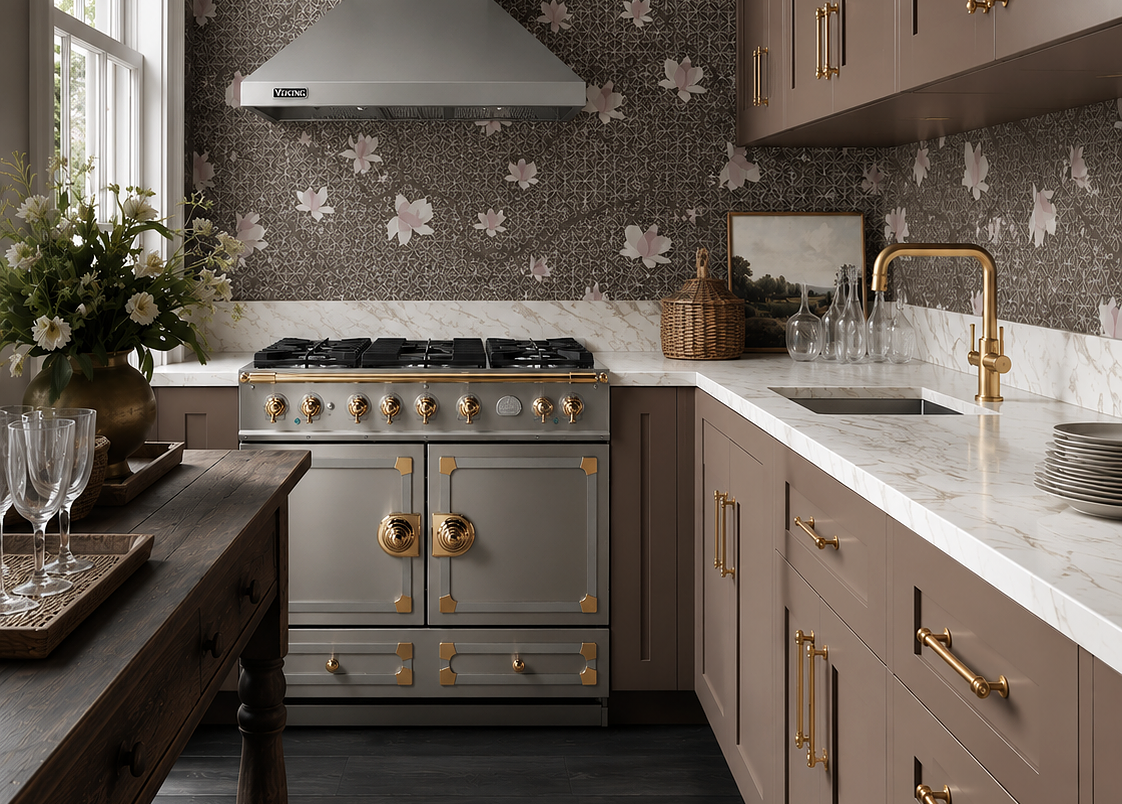
Open shelves hold crockery within reach because crockery is used daily, and daily use is not something to be ashamed of. Oak draining boards silver from water over years. Pantry cupboards sit painted in colours — deep bottle greens, tobacco browns, the particular soot-softened blue found in the back kitchens of Georgian rectories — that absorb shadow beautifully and disguise the honest wear of a working room. Peg rails carry brushes, baskets, aprons, and market bags in comfortable disorder. The range sits at the centre of everything, as it always has, radiating heat and a faint smell of warm metal through the house from October to April.
Nothing in such a room is arranged. It has simply settled.
The materials of the traditional English kitchen share a single quality that modern surfaces almost universally lack: they improve through use. Fireclay sinks record the mineral traces of hard water, the faint staining of tea, the softened rims where hands have rested. Soapstone absorbs the warmth of things placed upon it. Limestone flags grow smoother and more beautiful as the years accumulate. Unlacquered brass records the particular choreography of a household — which doors are opened most often, where fingers reach daily, which taps are turned with greater frequency. The room becomes, gradually and without intervention, a portrait of the life lived within it.
Modern interiors mistake luxury for the removal of evidence. Evidence of age, of wear, of accumulated use. Historic English interiors understood luxury as permanence — materials selected not for their novelty but for their capacity to endure and deepen. Joinery built to last three centuries and darken softly all the while. Shelves thick enough to bow slightly under the weight of years. Larders kept cool naturally by stone walls two feet thick. Nothing designed for replacement because nothing was designed to be fashionable.
This produces a quality of atmosphere that is almost impossible to manufacture deliberately.
A room built around utility acquires authority through repetition. The same loaves proved in the same tins beside the same warmth each Friday. The same boots pulled on at the same bench before the same walk across the same fields. The same copper kettle lifted from the same hook above the range each morning for forty years. Domestic ritual shapes a room more profoundly than decoration ever can, and it does so quietly, without announcement, simply by happening again and again in the same place.
The finest English kitchens being made today still honour this understanding. Their shelves remain open. Their brass is left to age. Their painted timbers will soften and chip at the corners and be all the better for it. Their stone sinks will stain and be all the better for that too. These are kitchens built with sufficient confidence in the quality of their materials to require no concealment — honest about craft, honest about use, honest about the fact that a working room is most beautiful when it looks like one.
This is not a philosophy of neglect. It is a philosophy of trust — trust in materials chosen well enough to be left alone, in craftsmanship sound enough to need no disguising, in the slow processes of habitation that no designer can replicate and no photograph can adequately convey.
A boot room should smell of wax and wet wool after rain. A pantry should feel several degrees cooler than the rest of the house. A kitchen should gather shadow in its corners by late afternoon and glow under lamplight on winter evenings with a warmth that has nothing to do with the light fittings.
None of this costs more than the alternative. It simply requires a different understanding of what a house is for.
Not for display. Not for photography. Not for the particular contemporary anxiety of a home that presents itself flawlessly to visitors who will notice every surface and judge accordingly.
For living in. For using. For leaving alone long enough that it becomes, in the fullest sense of the word, home.
The beauty of the English interior has always lived there — not in perfection, but in honest, accumulated, unhurried use.
It still does, for those with the patience to let it.