Room Study: The Oxford Kitchen
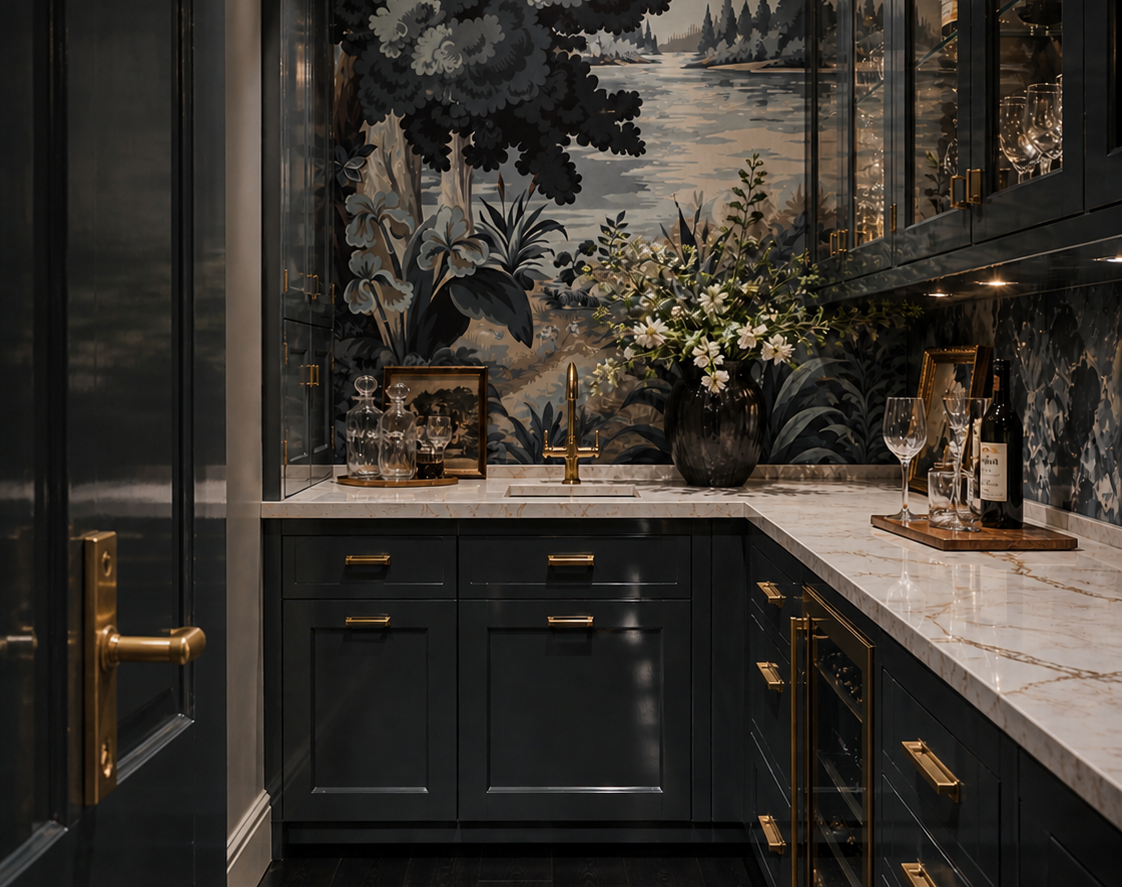
There is a kitchen in Oxford, England, and it is not a bright room. It does not want to be. The light comes in from the west in the afternoons and it comes in slowly, the way light moves through river water, and by the time it reaches the glass it has already been worn down by weather and cloud and the long grey patience of the English sky.
The men who built such rooms knew something that has since been forgotten or abandoned. They knew that darkness is not the enemy of a room. Darkness is what a room rests in, the way a man rests after long labor, settled into himself, not gone but quiet.
The cabinetry is black. Not painted black — it is black the way old iron is black, the way good soil is black after autumn rain has worked down into it. If you stand in that kitchen at noon you might catch a suggestion of blue beneath the surface, like water under ice, something alive under there and not quite willing to show itself. By evening it is gone. The wood takes everything in and gives nothing back but the edge of the marble and the slow gold of the brass fittings catching what little light the lamps allow.
There are men in the valley who hang wallpaper with trees on it and do not know why they do it. They say it is fashionable. They say their wives wanted it. But the instinct is older than fashion and older than wives and it goes back to something cold and honest in the blood — the knowledge that in winter, when the land is grey and the windows show you nothing but weather, a man needs to believe that somewhere there are still trees standing, that somewhere leaves are holding on.
The Oxford Kitchen has such paper on its walls. The trees are quiet in it. The paths wind somewhere beyond the frame of the room. And because the cabinetry is dark and the lamps are low, the paper does not look like decoration. It looks like what is actually outside. The window with its black frame becomes only one more opening in a landscape that has already come inside and settled down to stay.
Those old kitchens were never bright rooms. They were rooms built for work and for winter.
Women stood at those ranges for thirty years and the steam rose and the fires burned low toward morning and the copper pans darkened on their hooks and the walls took in the smoke and the smell of bread and wet wool and the particular exhaustion of people who had been useful all their lives. Nobody whitewashed those kitchens every season. Nobody ripped them out when the fashion changed in the city. They were allowed to deepen. They were allowed to become themselves.
The modern kitchen does not allow this.
Everything must be seen. Everything must be lit from above and reflected and confirmed and made legible at all hours like evidence in a trial. The marble is white and the cabinets are white and the walls are white and a man can stand in the center of it and see everything at once and feel, somehow, that he is in possession of something. He does not know that what he is missing is shadow. He does not know that a room without shadow is a room without memory.
You move differently in a dark kitchen. You are not in a hurry. You set the kettle on and you wait and the waiting does not feel like loss. Morning comes into the room sideways and finds you already there, your hands around something warm, the lamp still burning on the counter because you did not notice when it stopped being necessary.
There is a word for this and the word is inhabited.
The floor will soften in time where the feet go most — at the sink, at the range, at the place where a person stands to look out the window at nothing in particular. The brass will go dark at the handles where hands have closed around it for years. The marble will accept its scratches and its rings and its history the way a man accepts the marks a life leaves on him, without shame, because the marks are proof of something.
This kitchen will not age.
It will accumulate.
England has always known what the rest of us are still learning, or have learned and forgotten, or never quite believed — that the finest thing a room can do is hold you. Not impress you. Not display itself. Not announce its cost or its cleverness or its perfect adherence to the moment it was built in.
Just hold you.
The way good land holds rain.
The way a man holds a particular grief or a particular joy until it becomes indistinguishable from who he is.
The Oxford Kitchen gathers its darkness the way the valley gathers its fog — slowly, without apology, as if it has been doing this a long time and expects to go on doing it long after any one of us has finished our morning coffee and stepped back out into the weather.