Death of the American Kitchen
The kitchen lost its soul twice in America, and both times it happened because people were afraid.
Not the loud fear of war or famine, but the quieter kinds that settle into ordinary life and begin rearranging it from the inside. Fear of sickness. Fear of judgment. Fear of falling behind. Fear that one’s home might look old, cluttered, provincial, poor. Fear that personality itself might become a liability.
And so the kitchen, which had once been the warmest room in the house, slowly became the most cautious.
There was a time when kitchens bore the marks of living the way farmland bears the marks of weather. In the valley towns of California and the damp river counties farther east, morning light fell unevenly across pine floors softened by generations of footsteps. Oak drawers stuck slightly in winter when the air swelled with rain. Brass latches darkened beneath the salt and oil of human hands. The room smelled not of citrus-scented cleanser but of onion skins, coffee grounds, bread yeast, wood smoke, and damp cotton towels drying beside the stove.
The old kitchens were never silent.
A pot simmered low somewhere. Ice cracked in the sink basin. A screen door slapped shut at the back of the house while field dust drifted in through the window over the sink. Peaches sat ripening in bowls until their sweetness perfumed the room. Grease polished the edges of butcher-block counters where women stood every evening with tired feet and rolled sleeves, feeding families through droughts and lean winters and all the ordinary hardships that make up a life.
The kitchen was not decoration then. It was survival.
And because it was survival, it possessed dignity.
But in the years after the influenza pandemic of 1918, America began to look at the home differently. Disease had entered the public imagination with a new intimacy. Families who had watched loved ones cough themselves into the grave became obsessed with the visible performance of cleanliness. Science entered the domestic sphere carrying bleach and enamel and the promise that immaculate surfaces might keep death at bay.
White became more than a color. It became reassurance.
The kitchens of the 1920s turned pale and clinical. Wood disappeared behind porcelain and painted steel. Decorative carving gave way to flat surfaces that could be wiped in a single motion. Subway tile climbed the walls in orderly rows like institutional brickwork. Housewives were told that modernity itself lived in smoothness, brightness, and sterility. Dirt could not hide against white. Germs, people believed, could be conquered through vigilance.
And to be fair, this longing did not come from vanity. It came from grief.
Those women scrubbing porcelain sinks until their knuckles reddened were not fools chasing fashion. They had buried children. They had watched neighbors vanish within days from fever and fluid-filled lungs. If a gleaming kitchen offered even the illusion of protection, then the labor felt worthwhile. The shine of enamel became a kind of prayer against contagion.
Still, fear has a way of surviving long after the emergency itself has passed.
By the early twenty-first century, the American kitchen entered a second age of sterility, though this time the illness was cultural rather than viral. The country had grown suspicious of ornament, suspicious of inheritance, suspicious even of comfort. After decades of heavy cabinetry and decorative excess, a new aesthetic arrived promising purity through subtraction.
Suddenly every surface turned white or gray.
Cabinets flattened into featureless planes. Stone countertops stretched across rooms in seamless slabs engineered to resemble nothing actually quarried from the earth. Refrigerators vanished behind hidden panels. Handles disappeared. Shadows disappeared. Even the evidence of cooking itself seemed unwelcome. Toasters retreated into concealed compartments. Trash bins slid silently behind custom drawers. Kitchens no longer wished to admit that grease, steam, fish scales, onion skins, or spilled wine existed within civilized life.
The room began to resemble a luxury waiting area in a private clinic.
Its surfaces reflected light beautifully, but they held no memory.
Part of this transformation came from money. After the financial collapse of 2008, houses became investment vehicles with a new intensity. Property flipping spread through American suburbs and cities alike. Investors stripped homes of regional character and personal eccentricity in pursuit of something “universally appealing.” A painted tile mural might alienate a buyer. A dark green cabinet might narrow the market. Better, then, to remove every trace of taste entirely. Better to build a kitchen so neutral that nobody could object to it because nobody could feel anything about it at all.
The tragedy of the modern kitchen was not that it became ugly.
It was that it became afraid to be loved specifically.
At the same time, another force was quietly reshaping domestic life from behind illuminated screens. Homes no longer existed merely to be inhabited. They existed to be photographed. Social media rewarded brightness because brightness performed well on phones. White surfaces bounced light cleanly into tiny camera lenses. Pale rooms appeared larger online. Algorithms replicated sameness with mechanical efficiency until entire neighborhoods seemed assembled from the same handful of images.
The kitchen became a digital product before it remained a room.
Fruit sat untouched in decorative bowls. Open shelving displayed books whose spines had never been cracked. The room glowed beautifully at dusk and yet seemed strangely unwilling to feed anybody.
Even the materials themselves reflected a new relationship with permanence. Synthetic laminates and engineered stone spread rapidly because they were cheap to manufacture, easy to reproduce, and visually consistent. Natural wood contains contradiction: knots, mineral streaks, uneven grain, evidence of weather. Manufactured surfaces eliminated all of that. They did not age gracefully because they were never intended to age at all. They were designed instead to remain photographically unchanged until the next renovation cycle arrived.
The old kitchens expected inheritance.
The new kitchens expected resale.
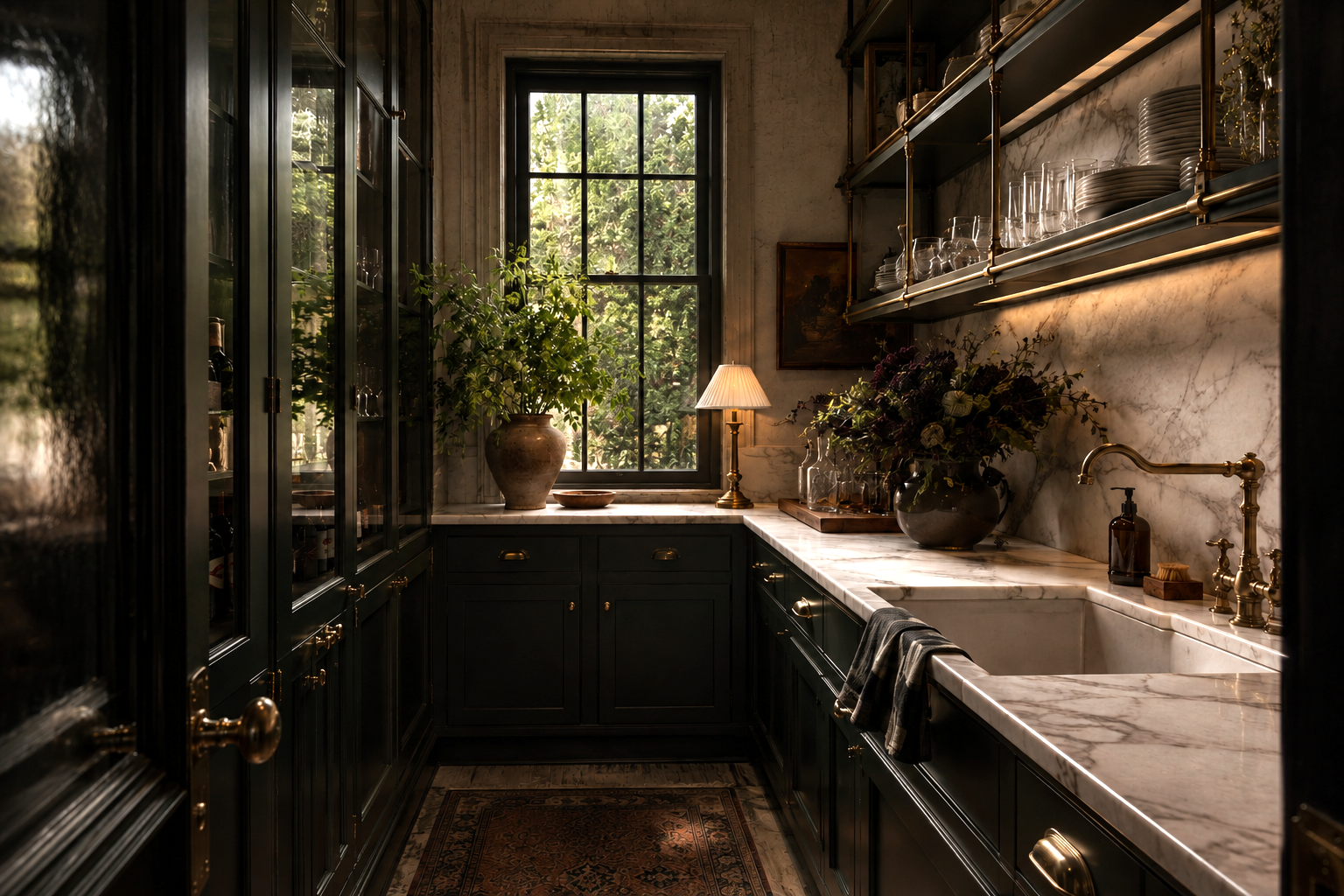
And yet people can endure only so much sterility before they begin hungering for warmth again. Across the country, the polished white kitchen has begun to lose its authority. Homeowners speak now of softness, texture, atmosphere. Wood grain has returned. Muted greens and ochres and earthen browns creep cautiously back into cabinetry and plaster walls. Kitchens once again allow shelves to hold imperfect dishes and counters to display signs of use.
This shift is often described as aesthetic, but it is something deeper than that.
It is exhaustion.
People are tired of living inside showrooms. Tired of rooms that look untouched even while occupied. Tired of homes that feel optimized for strangers rather than comforting to the people inside them.
Because a good kitchen is not static.
It bears witness.
Its floors wear smooth near the stove where generations stood stirring soup through winter evenings while rain tapped softly against the windows. Its drawers smell faintly of cinnamon and old recipe cards. A kettle leaves mineral ghosts on the range. Afternoon sun warms the worn edge of a wooden table where somebody shells peas into a chipped bowl. Somewhere a dish towel hangs drying beside the sink while broth simmers low in a heavy pot and the back door opens briefly to let in cold evening air.
No algorithm can manufacture that feeling.
No slab of polished stone can replace it.
The kitchen was never meant to resemble a museum for wealth or a photograph awaiting approval from strangers. It was meant to absorb life — the noise and residue and appetite of living people moving hungrily through ordinary days.
And perhaps that is why the sterile kitchen was always doomed in the end.
Because eventually, whether through memory or instinct, people remember that the rooms they love most are the ones that appear to love them back.